
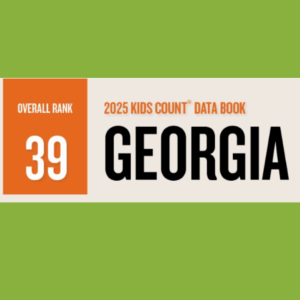
Families in Georgia (and right here in Habersham County) are facing mounting challenges, according to the newly released 2025 KIDS COUNT® Data Book, now available through the Family Connection website. The annual report, produced by the Annie E. Casey Foundation, offers a comprehensive look at child well-being across the country. Unfortunately, this year’s data shows Georgia slipping in overall child and family well-being, dropping two places to 39th out of 50 states.
This is Georgia’s lowest overall ranking in seven years, a reversal of recent progress. Despite past improvements, the latest data reveals troubling trends in economic well-being, health, and education—areas that deeply impact the future of Georgia’s children.
“This slip in progress is a stark reminder that we must persist in our work toward measurably better outcomes for all our children, families, and communities,” said Gaye Smith, Executive Director of Georgia Family Connection Partnership.
Key Takeaways from the 2025 Report:
-
Economic Struggles Deepen: Georgia fell from 32nd to 37th in economic well-being. An estimated 461,000 children—or 18% of Georgia’s youth—live in poverty, a 1% increase from the prior year.
-
Rising Child and Teen Deaths: Georgia saw a 21% increase in child and teen deaths since 2019, ranking 34th nationally.
-
Persistently High Low Birthweight Rates: Despite a slight improvement, 10.2% of babies in Georgia are born at low birthweight, ranking the state 47th.
-
Housing Burden Rising: From 2019 to 2023, the number of Georgia children living in housing-cost-burdened households rose by 66,000.
Not all the news is bleak. Georgia saw some gains in youth engagement:
-
The number of teens ages 16–19 not in school and not working fell to 7%, matching the national average and tying Georgia for 26th in this indicator—its best ranking since 2010.
Still, education metrics remain mixed:
-
70% of Georgia fourth graders scored below proficient in reading.
-
76% of eighth graders scored below proficient in math.
-
Graduation rates remained steady, though Georgia fell in ranking.
In the Family and Community domain, Georgia continues to rank in the bottom 10, with 38% of children living in single-parent households and 12% living with a head of household who lacks a high school diploma.
The full data for Georgia and Habersham County—including historical trends and local snapshots—is now available on the Habersham Family Connection website, where families, service providers, and community leaders can explore the statistics and find resources to help address the most pressing needs.
“We encourage everyone—schools, churches, businesses, and local leaders—to take a look at the data and ask: What can we do to help our children thrive?” said a representative from Habersham Family Connection.
Download the 2025 KIDS COUNT® Data Book.